
Why Sharing a Bed Means Broken Sleep for Couples
Over 50% of couples disagree on sleep temperature. Discover how mattress heat trapping drives conflict, sleep divorce, and what actually fixes the problem.
You both went to bed at a reasonable hour. You both logged seven hours. So why are you snapping at each other before the kettle's even boiled? If this pattern feels familiar, you're far from alone. Over 50% of couples have different thermal needs when sleeping [1], and 58% actively disagree on what the ideal sleep temperature should be [2]. Most couples blame personality, stress, or the kids. Almost nobody suspects the mattress.
What If the Real Problem Is Lying Underneath Both of You?
The standard framing goes like this: "He runs hot, she runs cold." It sounds like a quirk to manage, not a problem to solve. Separate duvets, a fan angled at one side, a nightly thermostat negotiation. But this misses what's actually happening at the mattress surface.
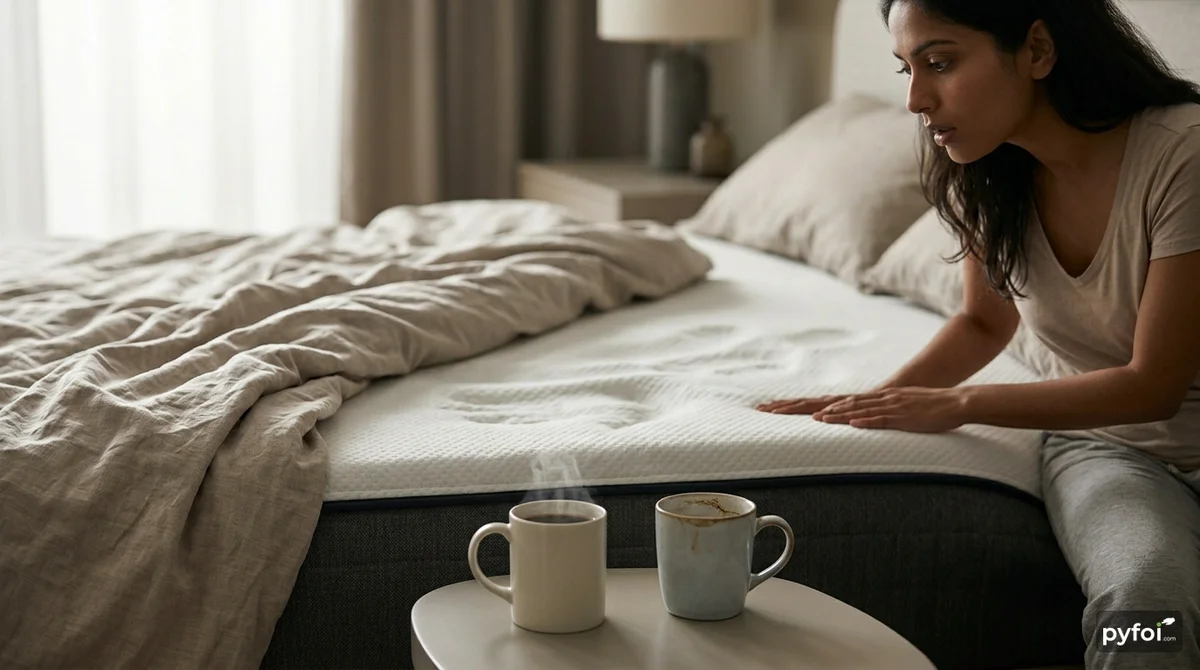
On a conventional foam mattress, body heat doesn't stay with one person. It transfers between sleepers and accumulates in the foam. The hotter partner effectively raises the surface temperature for both. Think of it like two people sharing a car seat with heated leather on a summer afternoon. Even if one person handles the warmth, the other's body heat makes the cabin worse for everyone. Except with a mattress, this plays out for eight hours straight, every single night.
The better questions to ask aren't "whose fault is the temperature argument?" but rather: How does our mattress handle heat from two bodies? Is the surface regulating temperature or just trapping it? Could our sleep environment be causing problems we're blaming on each other?
What the Research Actually Shows
The consequences go well beyond feeling a bit warm overnight:

- Invisible sleep fragmentation: Thermal discomfort triggers micro-arousals that pull you from deep sleep into lighter stages without either of you remembering. Seven hours on the clock can deliver the restorative equivalent of four or five.
- Next-day conflict: Research shows that when couples sleep poorly one night, they have more conflictual interactions the following day [3]. Poor sleep quality directly predicts increased anger and worsened perceptions of relationship quality [4].
- Partner contagion: Up to 30% of your sleep quality is influenced by your partner's sleep [5]. If they're tossing from heat, you're losing out too.
- Escalation to sleep divorce: The AASM's 2025 survey found 35% of couples now occasionally or regularly sleep apart, with the 35-44 age group most affected at 39% [6].
The irritability and reduced empathy that follow a fragmented night aren't character flaws. They're neurological consequences of prefrontal cortex impairment from sleep deprivation.
What Does This Actually Cost a Relationship?
Picture a Tuesday morning. You've had another rough night. Too warm under the covers, too cold without them. Your partner kicked the duvet off at 2am and you've been half-awake since. A minor disagreement about who forgot to buy milk turns into a ten-minute standoff. Neither of you is being unreasonable. You're both running on broken sleep.
Multiply this across weeks and months. Minor friction becomes entrenched coping: mismatched bedtimes, separate blankets, one person migrating to the couch. Eventually it becomes "sleep divorce." That path carries real costs: spare bedroom furniture runs $2,000-$5,000, and couples counselling sits at $150-$300 per session. The mattress, silently radiating trapped heat from two bodies, is rarely part of the conversation.

A Smarter Way to Think About Couples Sleep
Rather than treating temperature as a nightly compromise, consider a framework that addresses the root cause:

- Evaluate thermal regulation as a pair: When mattress shopping, lie on the bed together for at least 15 minutes. A quick solo sit-down tells you nothing about how the surface handles shared body heat.
- Ask the right question: "How does this mattress manage heat from two different bodies over a full night?" If the retailer can't answer, that's telling.
- Factor in life stages: If one partner is perimenopausal or menopausal, temperature regulation becomes urgent. 70% of menopausal hot flashes are associated with waking, and research shows a cooling mattress reduced vasomotor symptoms by 52% over eight weeks [7].
How to Actually Fix the Temperature Divide
Start by accepting that temperature incompatibility in bed is a mattress engineering problem, not a relationship problem.
Understand what "cooling" really means. Many mattresses marketed as cooling use breathable covers or gel-infused foam. These help for 10 to 15 minutes before the heat builds again. Look for materials that regulate continuously, absorbing excess heat when the surface warms and releasing it as things cool.

Look for independent thermal response. Phase-change materials work differently from powered dual-zone systems. Microcapsules embedded in the mattress respond at each point on the surface: the hotter sleeper's side absorbs more heat, the cooler sleeper's side holds warmth. No controls, no compromise, no negotiation.
Do the maths on delay. A quality temperature-regulating mattress costs $1,500-$3,000 and targets the root cause. Compare that against years of workarounds, supplementary cooling gadgets, and the relationship strain of chronic broken sleep.
Test as a couple, not alone. Showroom tests done solo miss the entire thermal interaction that happens when two bodies share a surface overnight.
The temperature disagreement in your bedroom isn't a sign that you're incompatible. It's a sign that your mattress isn't doing its job. Fix the surface, and you might just fix the mornings.
You may also be interested in these independent articles
Sources
- [1]Help for Couples Who Argue About Sleep Temperature - Sleep.me
- [2]Help for Couples Who Argue About Sleep Temperature - Sleep.me, 2024
- [3]Quarreling After a Sleepless Night: Impact of Sleep Deprivation on Interpersonal Conflict - PMC, 2022
- [4]Poor Sleep Quality Predicts Increased Anger and Worsened Relationship Quality - SAGE Journals, 2023
- [5]Sleeping Together: Understanding and Optimizing Couple Sleep - Oxford Academic, 2024
- [6]New Survey Data: Sleep Divorce - AASM, 2025
- [7]Cooling Mattress Pad and Vasomotor Symptoms - PubMed, 2022
© 2026 pyfoi. All rights reserved.