
Is Your Mattress Ready for the Hottest Summers Ever?
Australian and New Zealand summers are getting hotter. Find out why your mattress traps heat no air conditioner can fix and how to buy for a warming climate.
You're about to spend a few thousand dollars on a mattress you'll sleep on for the next eight to ten years. You'll test firmness, check the price, read a few reviews. What you probably won't consider is the climate you'll be sleeping through over that decade. In Australia, very hot nights now occur five times more often than they did in the 1960s [1]. In New Zealand, extreme temperatures are already five times more frequent than historical baselines [2], and heatwave frequency is projected to double by the 2050s [3]. The mattress you buy this year will serve through the hottest summers in recorded history.
What if room cooling can't solve a mattress problem?
When the forecast hits 30 degrees overnight, most people reach for the same fix: turn on the aircon, open a window, switch to lighter sheets. These all target the air in the room. But the heat disrupting your sleep isn't in the air. It's trapped between your body and your mattress surface.

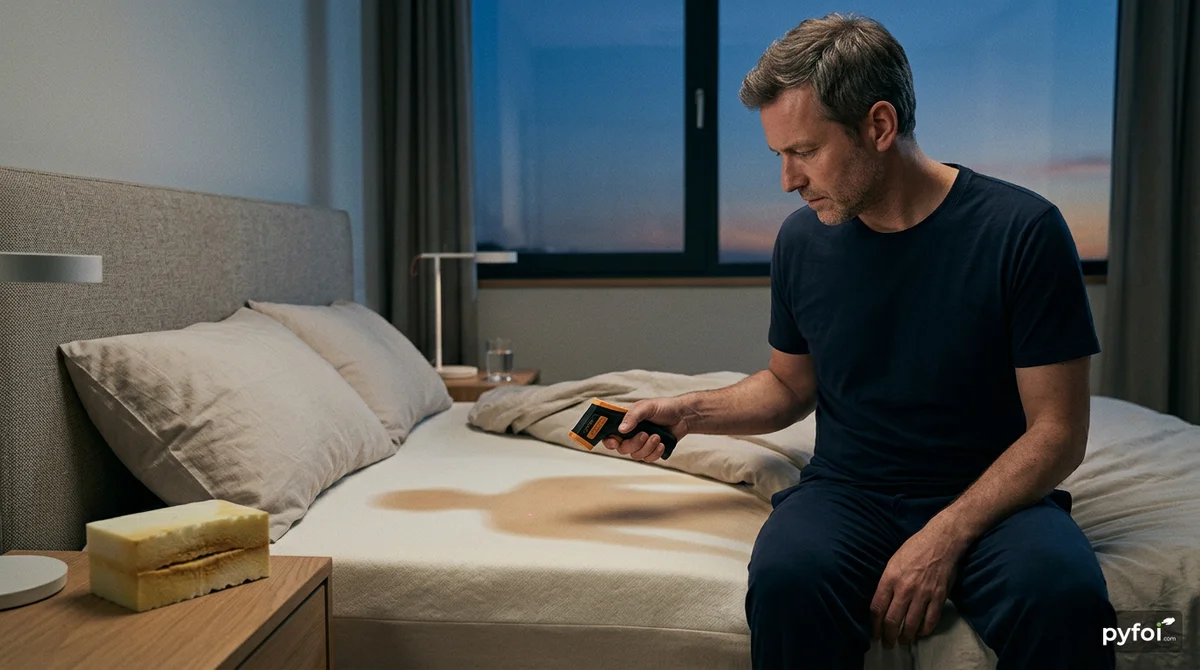
Standard foam absorbs your body heat and holds it against your skin, creating a microclimate independent of room temperature. You could cool your bedroom to 18 degrees and the surface beneath your back would still sit around 35 [9]. No fan or air conditioner can reach into that gap.
Instead of "How do I cool my bedroom?", consider: How much heat does my mattress trap over eight hours? Will foam degradation make it worse over time? And can the surface handle overnight temperatures that are measurably rising year on year?
Why this problem compounds faster than you think
The evidence stacks up quickly:

- Very hot nighttime temperatures occurred about 2% of the time between 1960 and 1989. They now occur roughly 10% of the time [1].
- Auckland's abnormally hot nights were nearly three times more common in the 2010s than the 1930s [4].
- By 2099, projected sleep loss from warming is estimated at 50 to 58 hours per person per year [5]. That trajectory is already in motion.
- Running bedroom air conditioning overnight in Australia costs $1.50 to $2.50 per night ($200 to $500 per year), yet it fails to address the mattress-surface microclimate.
- Foam degrades with use. Heat retention you notice in year one gets worse by year five as materials compress and densify.
Your mattress is a thermal system that performs worse over time, in a climate that's getting harder on it every year.
What hotter nights actually feel like in a New Zealand home
Here's the other half of the problem. Seventy-five percent of New Zealand homes have insufficient ceiling insulation, and 70% lack underfloor insulation [7]. The average bedroom temperature between midnight and 9am sits at just 13 degrees Celsius, five degrees below the WHO minimum [8]. Bedrooms swing between freezing in winter and stifling in summer.

Imagine a February night in 2030. Your house has been soaking up heat all day. The bedroom won't drop below 24 degrees until well past midnight. You're lying on a four-year-old mattress with foam that's lost its resilience. Your lower back is damp, your heart rate feels elevated, and by 3am you've given up on deep sleep entirely. You blame the weather, but the real problem is the surface holding every watt of body heat against your skin.
The cost of inadequate sleep in Australia alone runs to $45.21 billion annually [6]. It shows up in your productivity, your patience, and your health.
How should you actually evaluate a mattress for a warming climate?
Shift the buying framework from "how does it feel right now?" to "how will it perform across a decade of hotter summers?"

- Ask about thermal regulation, not just breathability. Airflow helps with moisture, but what you need is a material that actively manages heat at the surface where your body makes contact.
- Separate room cooling from surface cooling. Your heat pump handles the air. Your mattress has to handle the contact surface. These are different jobs.
- Think about degradation. Ask how the mattress performs at year five, not just day one.
- Factor in energy costs. Passive thermal regulation costs nothing to run. Air conditioning costs hundreds per year and still misses the microclimate.
What does a climate-smart mattress purchase actually look like?
When you test mattresses, go beyond firmness and feel. Ask the retailer: "What happens to the surface temperature after four hours of body contact?" If they can't answer, that tells you something.
Look for phase-change materials that absorb excess body heat as it builds and release it as you cool down. This technology holds the mattress surface closer to 29 degrees compared to 35 on a standard mattress [9]. That six-degree buffer works without electricity and doesn't degrade the way foam does.
If you're already running overnight air conditioning, a thermally regulated mattress reduces how hard your cooling system works, cutting energy costs while solving the problem AC was never designed to fix. If you're renting and can't control your home's insulation, a mattress with built-in thermal management is the single most effective intervention available.
Your next mattress isn't a comfort purchase. It's an eight-to-ten-year bet on how well you'll sleep through a changing climate. Buy one that gets better at its job as nights get warmer, not worse.
You may also be interested in these independent articles
Sources
- [1]Australia's Changing Climate - CSIRO
- [2]NIWA Climate Change Scenarios for New Zealand
- [3]New Zealand Summers Set to Sizzle - PreventionWeb
- [4]Why Our Summers Feel So Much Hotter - Newsroom NZ
- [5]Warmer Nights and Sleep Loss - Inside Climate News
- [6]Asleep on the Job: Costs of Inadequate Sleep in Australia - Sleep Health Foundation
- [7]NZ Housing Often Damp, Cold and Built to Code - RNZ
- [8]EHINZ Indoor Environment - NZ
- [9]KulKote Temperature Regulating Technology - Sleepyhead NZ
© 2026 pyfoi. All rights reserved.