
Are You Blaming Stress for a Problem Your Mattress Is Causing?
Most adults blame stress for poor sleep, but a heat-trapping mattress may be the real cause. Learn how thermal disruption mimics stress and what to do about it.
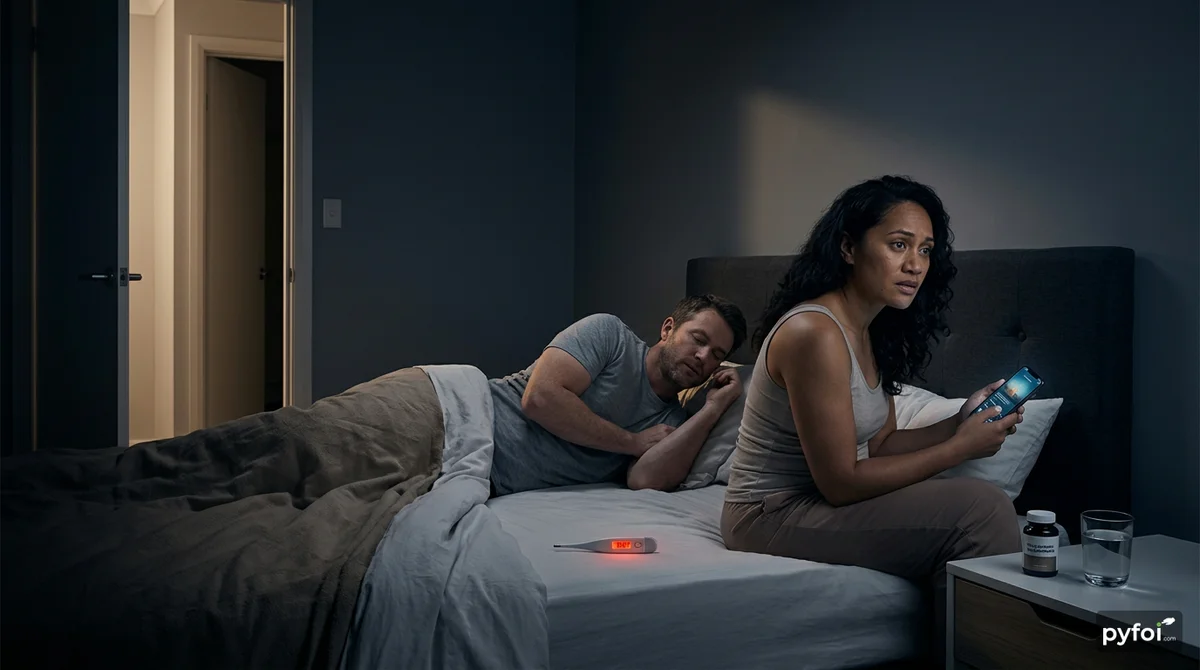
You know the pattern. Lights off, body tired, mind suddenly spinning. You wake at 3am with your thoughts racing and spend the next two hours staring at the ceiling. By morning you are drained, and the explanation writes itself: stress. Nearly 75% of adults point to stress as the reason they sleep poorly [1]. It makes sense. You can feel the tension in your shoulders. You can hear your own thoughts. But what if the trigger is not in your head at all?
What if your body is overheating and your brain is taking the blame?
Here is something most people never consider. Your body must drop its core temperature by roughly one degree Celsius to initiate and sustain deep sleep [2]. This happens as heat flows outward through your skin into whatever surface you are lying on. When that surface traps heat and reaches the same temperature as your body, the cooling process stalls.
A standard foam mattress absorbs your body heat and holds it. Within a few hours the surface reaches thermal equilibrium with your skin and the downward heat pathway shuts. Your brain responds exactly as it would to stress: lighter sleep stages, more frequent waking, elevated heart rate. You feel wired, frustrated, and mentally busy. But the root cause is thermal, not psychological.
The questions worth asking shift completely. Instead of "Why can't I switch off?", try: Is my mattress trapping heat? Does the surface temperature rise through the night? Am I confusing a temperature problem with a stress problem?
What does the evidence actually show?
The case for thermal disruption masquerading as stress is stronger than most people realise:
- Deep sleep onset is most likely when core temperature is declining at its steepest rate [2]. A heat-trapping mattress flattens that decline.
- A 2024 three-centre study found that improving conductive heat loss through the mattress surface increased deep sleep (N3) by 7.5 minutes per night and lowered resting heart rate by 2.36 bpm, in healthy subjects with no diagnosed stress or anxiety [3].
- The disruption concentrates in the second half of the night, when the body's circadian temperature minimum hits around 3 to 4am. Heat-trapping materials make this vulnerable window worse, producing the classic "3am waking" pattern [2].
- People who wake at 3am spend 34% more time in light N1 sleep during the back half of the night [2].
- Between 33% and 45% of Australian adults report inadequate sleep, and affected individuals lose an average of six productive workdays per year [4].

You can introspect on your thoughts. You cannot feel your core temperature gradient. That asymmetry is why the mattress escapes suspicion entirely.
What does this actually feel like night after night?
Imagine lying awake at 3:15am. Your lower back is warm against the sheet. Your mind cycles through tomorrow's to-do list, a conversation you should have had, the mortgage. It feels unmistakably like anxiety. You get up, drink water, scroll your phone, try a breathing exercise. Nothing works because the problem is underneath you, not inside you.
Over weeks this builds. You start to question your mental health. You download a meditation app, buy magnesium supplements, maybe book a GP appointment. Apps, supplements, weighted blankets, and therapy programmes can easily cost $200 to $600 a year. None of it addresses the layer of foam holding 35-degree heat against your skin all night. The real cause sits in your bedroom disguised as furniture.

How should you rethink what is keeping you awake?
Before investing in another stress management tool, test a simpler hypothesis. Use these four filters:
- Track the timing. If you consistently wake in the second half of the night (between 2am and 5am), thermal disruption fits the pattern more closely than psychological stress, which tends to delay sleep onset.
- Notice where you feel warm. Lower back, shoulders, and hips pressed against the mattress are where heat builds fastest. If those areas feel clammy at waking, temperature is a factor.
- Ask your mattress what it does with heat. Not whether it is "breathable" or has "cooling gel," but whether the surface actively conducts heat away from your skin over a full eight hours.
- Separate the symptoms. Racing thoughts at 3am can be a consequence of thermal arousal, not a cause of poor sleep. Your brain looks for explanations when your body wakes it up.

What should your next step actually be?
Rule out the mattress before committing to stress-based interventions. When you shop, ask retailers directly: "How does this mattress manage surface heat after four hours of body contact?" If the answer is vague or limited to marketing terms, keep looking.
Look for materials with high thermal conductivity or phase-change properties that absorb excess body heat as it builds and release it as you cool. Research shows these surfaces hold closer to 29 degrees compared to 35 on standard foam, a difference you cannot see but your body registers immediately [5].
If you already sleep well on holidays or in air-conditioned hotels but poorly at home, the variable is not your stress level. It is your sleep surface. A mattress that conducts heat away restores the core temperature decline your body needs for deep sleep, without pills, apps, or subscriptions.
Stop treating the symptom. Test the surface.
You may also be interested in these independent articles
Sources
- [1]Stress and Sleep - American Psychological Association, 2013
- [2]The Temperature Dependence of Sleep - Harding & Franks, 2019
- [3]Enhanced Conductive Body Heat Loss During Sleep Increases Slow-Wave Sleep and Calms the Heart - Harding et al., Scientific Reports, 2024
- [4]Effects of Thermal Environment on Sleep and Circadian Rhythm - Okamoto-Mizuno & Mizuno, 2012
- [5]KulKote Temperature Regulating Technology - Sleepyhead NZ
© 2026 pyfoi. All rights reserved.