
Are You Judging Your Mattress by 3% of the Night?
Showroom comfort covers 15 minutes of an 8-hour sleep. Learn why subjective mattress trials miss 97% of the night and how to test for real sleep performance.
You spent a Saturday afternoon lying on mattresses in a showroom. Five minutes here, ten minutes there. You picked the one that felt right and paid good money for it. Maybe you took advantage of a 100-night trial and decided after a few weeks that it felt fine. You kept it. Yet most mornings, you wake up groggy, wondering whether you need more sleep or better supplements. What if the problem is the mattress you already decided was comfortable?
What if "comfortable" isn't the right test?
Eighty-six percent of mattress buyers cite comfort as their most important purchase factor [1]. That makes sense on the surface. But here's the blind spot: the comfort you can consciously feel covers roughly 15 minutes of your night. That's the time it takes to fall asleep, plus any moments you briefly wake. The other seven-plus hours? You're unconscious. You have no idea what's happening.

Think of it like buying a car based entirely on how the driver's seat feels in the dealership car park. You'd never skip the test drive or ignore fuel economy. Yet the industry has trained us to trust a 15-minute lie-down as proof of an eight-hour purchase.
The questions worth asking are different. How does this mattress perform thermally at hour four? What happens once my body heat saturates the materials? Will it support deep sleep stages I can't consciously feel?
What's actually happening while you sleep?
The science is clear, and it runs counter to how most people shop:

- Gel foam feels cool at bedtime, but gel thermally saturates within 15 to 20 minutes. That initial coolness covers just 3% of a 480-minute sleep cycle [2]. After saturation, the mattress surface climbs to 33 to 35 degrees Celsius, and stays there.
- Hot sleepers report poor sleep quality at significantly higher rates: 24% compared with 17% for those who sleep at a neutral temperature [3].
- A temperature-controlled mattress study found participants gained 22% more deep sleep and 25% more REM sleep, yet the sleepers themselves could not detect the difference subjectively [4]. The improvement was invisible to them but measurable by instruments.
- Ten hours of fragmented sleep is less restorative than seven hours of intact sleep architecture. What your brain does during those hours matters more than the total.
- Heat-induced suppression of slow-wave sleep reduces insulin sensitivity within three nights. This is not a long-term risk. It starts almost immediately.
What does a misjudged mattress cost you over time?
Imagine you've had your mattress for two years. You sleep seven and a half hours most nights. You feel okay, not great, but you blame work stress or the kids. Meanwhile, your mattress surface is running at 34 degrees from midnight onwards, quietly fragmenting your deep sleep and trimming your REM cycles.
You're not tossing and turning. You're not waking up drenched. There's no obvious signal. But your focus at work is softer than it used to be. Recovery after exercise takes longer. Your patience with your partner or kids has a shorter fuse. The mattress passed your comfort test. It failed the sleep test you never ran.
That gap between what feels fine and what actually performs is where years of suboptimal sleep hide. You can't fix a problem you can't feel.
How should you actually test a mattress?
Stop relying on subjective feel as your primary measure. Shift to a framework built around measurable sleep performance:

- Track sleep stages, not just comfort. Consumer sleep trackers now show reasonable agreement with clinical polysomnography for detecting sleep stage patterns [5]. Use one during any home trial period.
- Compare week one with week three. Initial comfort impressions tell you almost nothing about thermal performance. Give your sleep data at least two to three weeks to reveal patterns.
- Ask about thermal saturation, not just cooling labels. "Cooling gel" describes how a mattress feels for the first 15 minutes. Ask the retailer what happens at hour four.
- Prioritise active thermal regulation. Materials that continuously manage heat at the skin-contact surface perform differently from materials that simply feel cool on first contact.
What does a smarter mattress purchase look like?
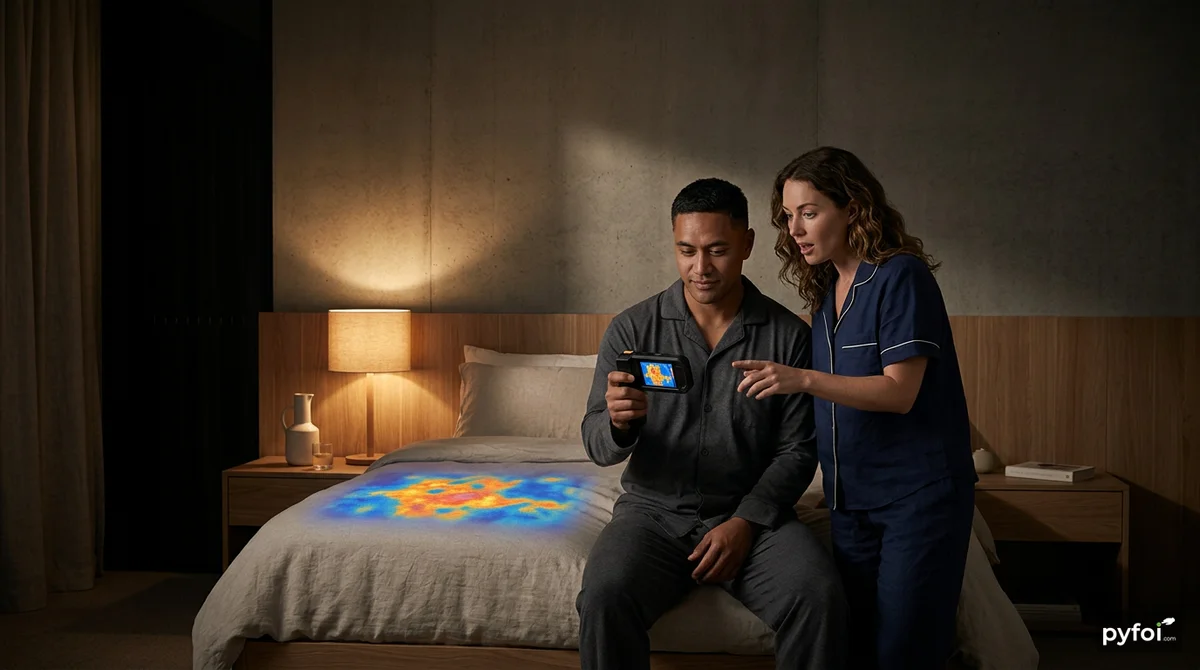
Start by wearing a sleep tracker for a week on your current mattress. That gives you a baseline for deep sleep and REM percentages. When you trial a new mattress, run the tracker again for at least two weeks and compare the numbers, not your morning feelings.
When shopping, ask pointed questions. What is the surface temperature after four hours of body contact? Does the cooling technology work passively all night, or does it fade? Can you show me thermal data rather than marketing language?
If a retailer cannot answer, treat that as information. A mattress backed by measurable thermal data is a different proposition from one sold on showroom feel alone.
Look for phase-change or temperature-regulating materials that manage heat continuously through the night, not just at sleep onset. The 22% deep sleep gain found in controlled studies came from sustained thermal management, not from a cool first impression [4].
Your mattress doesn't need to feel different. It needs to perform differently during the hours you'll never remember. Test for that, and you'll make a purchase your body benefits from, even if your conscious mind can't tell the difference.
You may also be interested in these independent articles
Sources
- [1]Consumer mattress purchase decision factors - Statista
- [2]Gel thermal saturation and sleep cycle coverage - Bioengineering, 2024
- [3]Hot sleeper sleep quality survey data - Amerisleep
- [4]Temperature-controlled mattress sleep architecture study - Bioengineering, 2024
- [5]Consumer sleep tracker validation against polysomnography - PMC10654909
© 2026 pyfoi. All rights reserved.